
"Should I tell her what I know?"
Nadia had heard something at a party about a friend's partner. Second hand, from someone who enjoyed telling it, and specific enough to be either true or a very good piece of malice. Nadia had been carrying it for a fortnight and had started avoiding the friend rather than lie by omission in person.
Should I tell her what I know?
The card
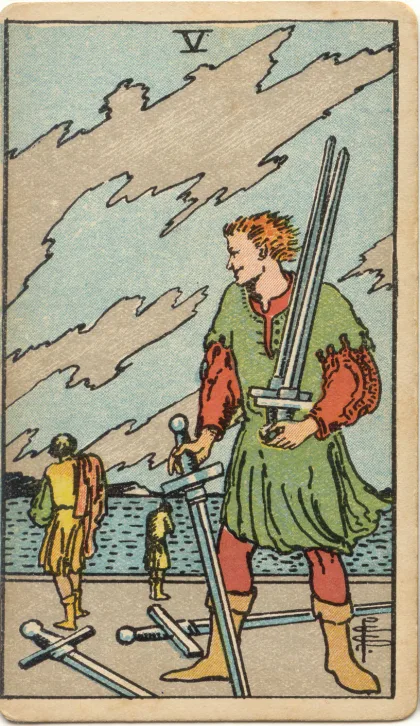
Five of Swords, upright — a hollow win, conflict, cost of being right.
You could win this and lose more than you gain. Ask what the victory actually buys.
The short answer
No
The reading
The picture is a smirking figure gathering up swords while two others walk away along the shore with their backs turned. It is the only card in the suit where somebody has clearly won, and it is one of the least happy images in the deck. That is the entire content of the Five of Swords: a victory that cost the field it was won on.
Take the no as being about what you are holding rather than about honesty. What you have is not knowledge. It is a story told at a party by somebody who enjoyed telling it, and the word know in your question is doing work the evidence cannot support. Passing it on would make you the person who told her, permanently and regardless of whether it turns out to be true, and if it is not true you will have spent a friendship on a rumour. That is the hollow win the card is standing in the middle of.
There is also a version of this where telling her is genuinely for you rather than for her — because a fortnight of carrying it has been unpleasant, because avoiding her is worse than the fortnight, because saying it out loud would make it somebody else's problem. That is not wickedness, it is just relief looking like duty, and it is worth checking which one is driving before you speak. The card is unusually good at spotting that particular substitution.
None of which means say nothing forever. It means what you have is not yet worth saying. If you can find out whether the person who told you actually saw anything, that changes the object in your hands from gossip into something with a shape. If she asks you directly, the answer is not a lie — that is a different question with a different card behind it. And if this is not a rumour at all but something that puts your friend at risk, then it stops being a question about tact and you should say it plainly and quickly, to her and to anyone else who needs to know.
What you can do now, without a single sword in your hand, is stop avoiding her. The distance you have opened up over a fortnight is a real thing happening to a real friendship, and it is being caused by a story you are not even sure of. Whatever you decide about telling, that part is worth undoing this week.
What this one shows
The card answered a question about speaking with a question about cost, which is what the Five of Swords does. Note also what the reading refused to do: it did not tell Nadia whether the story was true, because a card has no access to that, and any reading that pretended otherwise would be inventing the one fact the whole decision turns on.
A story, not a transcript. Nadia is invented and so is the party; the question is the shape people really ask in.
← Should I lend my brother the money? · All ten stories · Should I start the business? →