
"Should I lend my brother the money?"
Marcus had the money and did not really want to give it. The amount was survivable, the brother was in a hole that was partly of his own digging, and there had been a smaller version of this two years ago that was never mentioned again. Their mother had raised it twice in a week.
Should I lend my brother the money?
The card
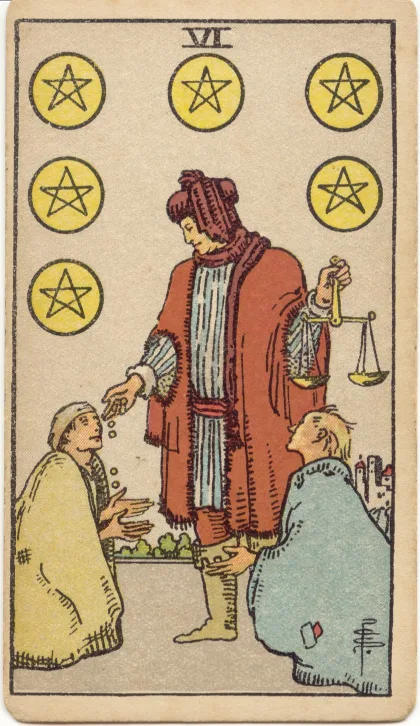
Six of Pentacles, reversed — strings attached, unequal giving, debt.
The generosity has conditions, or the exchange is lopsided. Check what is expected in return.
The card came out upside down, which is why it is printed that way here. Reversed is not the opposite of upright — the upright Six of Pentacles is fair exchange, and reversed it is the same scene with the scales not quite level.
The short answer
Perhaps
The reading
Upright, this card is a merchant with a pair of scales in one hand, dropping coins into the palms of two kneeling figures. It is usually read as generosity, though it has never been an entirely comfortable picture: one person is standing, two are kneeling, and the standing one is holding the instrument that decides how much. Reversed, that discomfort is the whole card. Somebody in the arrangement is holding the scales, and it is not the person receiving.
So the perhaps is not about whether you can spare it. It is about what the money would be carrying. The card is asking you to say out loud, to yourself first, what you expect in return — and the honest answer is rarely nothing. It might be repayment, or an acknowledgement, or an end to the phone calls, or simply that the two-year-old version of this finally gets mentioned. None of those are disgraceful things to want. They only become a problem when they travel with the money unspoken, because then they cannot be met, and the resentment when they go unmet lands on a brother who was never told they existed.
Your mother raising it twice in a week is part of the arrangement and belongs in the reckoning. Some of the pressure you are feeling is not coming from the person who needs the money, and a decision made to end a family conversation is a decision that has been made for you by the wrong person. Whichever way you go, it is worth being able to say plainly that you went that way for your own reason.
The practical shape the card favours is the unromantic one: decide whether this is a gift or a loan, and say which it is. A gift is money you have chosen to lose, and if you can afford to lose it the relationship survives it. A loan is a loan, with an amount and a rough date, said aloud once and not repeated monthly. What ruins this between brothers is the third thing — money handed over as a gift and quietly accounted as a loan, which is exactly what the reversed card is standing in the middle of.
And nothing here is financial advice. Money that would leave you in real difficulty is not a question for a card. If that is the position, the reading is simply no, and the conversation to have is with your brother rather than with the deck.
What this one shows
A perhaps often means the question has a condition inside it that has not been named yet. The reading did not tell Marcus what to do with his money — it told him what to settle before he did anything, which is the part a card can legitimately reach.
A story, not a transcript. Marcus is invented and so is the brother; the question is the shape people really ask in.
← Should I stick with the course? · All ten stories · Should I tell her what I know? →