
"Should we buy the house?"
Tom and his partner had an offer accepted on a house they liked and could nearly afford. Two viewings, a survey with the usual list of unalarming faults, and a gap between what they had planned to spend and what they had agreed to. The question was asked at half past eleven, alone, in the way these things are.
Should we buy the house?
The card
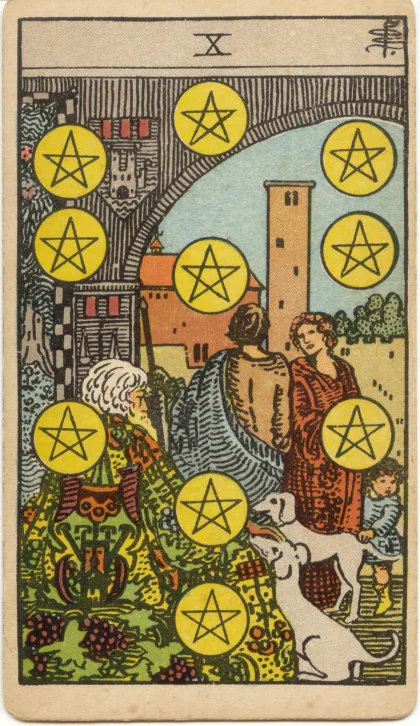
Ten of Pentacles, upright — lasting wealth, family, legacy.
Long-term security, and more than one generation of it. Houses, inheritances, things that outlast you.
The short answer
Yes
The reading
Of the seventy-eight cards, this is the one that most literally shows a house. An old man sits under an archway with two dogs, a couple talk in the courtyard, a child holds on to the older figure's robe, and ten pentacles are laid across the whole scene like a lattice. Nothing in the picture is being acquired. It is a card about a place that has already been lived in, by more than one generation, long enough to stop being a transaction.
That is the yes, and it is worth reading precisely. The card is not confirming that the price is right or the survey is fine — it has no opinion about the gap between what you planned to spend and what you agreed to, and neither the card nor this reading is financial advice. What it says is that the thing you are buying is the right kind of thing for you: not an investment, not a rung, a place to be in for a long time. If that is the register you have been thinking in, the card agrees with you.
Where the Ten of Pentacles is genuinely useful at half past eleven is on the question of what the money is for. A gap of a few thousand looks enormous against a spreadsheet and fairly small against fifteen years of Sunday afternoons, and which of those comparisons is the honest one depends entirely on whether you are actually going to be there for fifteen years. That is the question this card puts to you, and it is one you and your partner can answer between yourselves without any help from a deck.
The other half of the picture is that the courtyard has people in it. This card is never about a building on its own — it is about a household, and about agreement between the people in it. If the two of you are not in the same place about the amount, the card is a poor substitute for the conversation, and the conversation is much easier now than it will be in three years when one of you remembers having had doubts.
So the reading is yes, with the ordinary conditions any sensible person would put on it: the survey read properly rather than skimmed, the payments checked against a worse year than this one, both of you actually agreeing rather than one of you going along with it. None of that is mystical. But you asked at half past eleven, and the card's answer to what the house is for is about as reassuring as the deck gets.
What this one shows
The card can speak to the kind of decision you are making even when it cannot speak to the numbers. Notice that the reading declined the financial question outright and answered the one underneath it — whether this is a fifteen-year house — which is where a reading legitimately has something to say.
A story, not a transcript. Tom is invented and so is the house; the question is the shape people really ask in.