
"Should I take the job?"
Owen had an offer on the table with four days left to answer it. More money, a title with the word lead in it, a company that talked a great deal about where it was going and rather less about where it was. The current job is fine. Fine is the problem.
Should I take the job?
The card
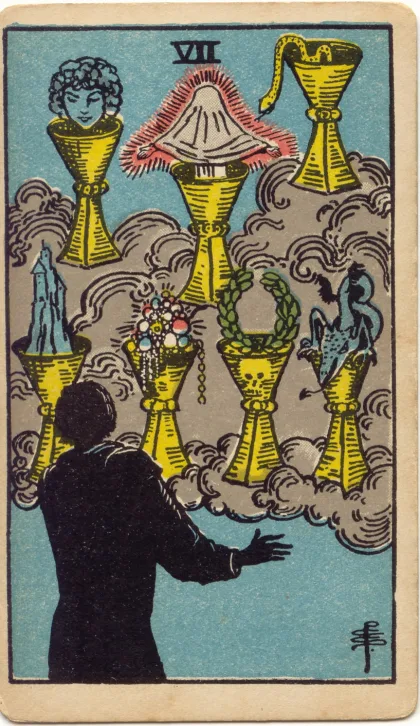
Seven of Cups, upright — too many options, fantasy, unclear.
Several possibilities, most of them imagined rather than real. Nothing can be decided until you work out which cups have anything actually in them.
The short answer
No
The reading
Read the no carefully, because it is narrower than it looks. The Seven of Cups is not saying the job is bad. It is saying you cannot see it yet, and that saying yes to something you cannot see is a decision made on a picture rather than on a thing.
Look at what the card shows. Seven cups float in front of a figure in silhouette, and each one holds something: a castle, a wreath, jewels, a face. The figure is not choosing between seven offers. The figure is looking at seven images, and the card's whole argument is that most of them will not survive being touched. What you have been told about this job is a set of images — lead, the trajectory, the thing they said about where the company is going in eighteen months. What you have actually been offered is a contract, a manager, a team and a set of Tuesdays.
The word fine is doing a lot of work in how you have framed this, and it is worth separating from the offer entirely. Wanting out of a job that is fine is a real and sufficient reason to move. But it makes any alternative look bright, because the comparison is not being made between two jobs — it is being made between a known dullness and an unknown that has been described to you by people who want you to say yes. That is not a fair fight, and the card is pointing at the unfairness rather than at the job.
Which cup has something in it is a question you can actually answer in four days. Who would you report to, and can you speak to them again. What happened to the last person in this role. How is the company funded and until when. What does lead mean here in terms of headcount and budget, written down. Ask three of those and the picture either firms up into something you can weigh, or it stays a picture — and a picture that will not firm up under a direct question has told you what it is.
So the card says not on what you know now. It does not say never, and it does not say your current job is where you belong. It says the version of this job you are deciding about lives mostly in your head, and four days is enough time to replace some of it with facts.
What this one shows
A no is not always a refusal. Here it attached to the timing and the information rather than to the job — the card came back negative because the decision was being made on imagination, and that is a fixable condition. Owen asked two of those questions and took the job a week later. The reading was not wrong; the thing being decided about had changed.
A story, not a transcript. Owen is invented and so is the offer; the question is the shape people really ask in.
← Should I go on the date? · All ten stories · Should I text him first? →