
"Should I go on the date?"
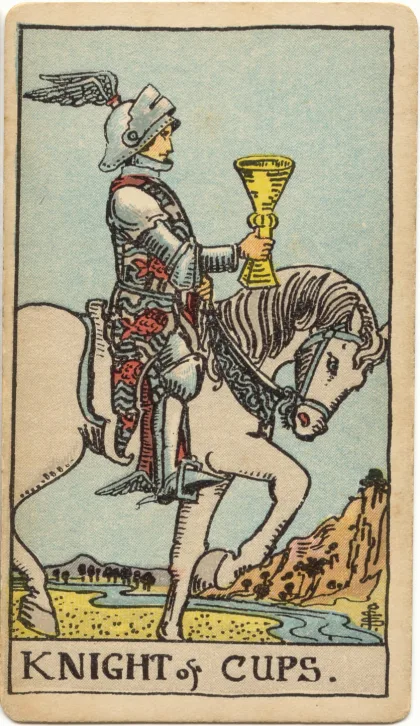
Jane had been messaging someone for three weeks and had said yes to a Thursday before the nerve went. The last relationship ended badly enough that Jane no longer trusted their own read on anyone, and by Tuesday the plan was to invent a work thing. Then, instead, a question in one sentence.
Should I go on the date?
The card
Knight of Cups, upright — a proposal, romance, following feeling.
Someone arrives with an offer made from genuine feeling. Charming, and worth hearing out.
The short answer
Yes
The reading
You are not really asking whether this person is worth a Thursday evening. You would not have got as far as drawing a card if you thought they were not. What you are asking is whether you can still be trusted to tell — and that is a different question, and a fairer one to yourself.
The Knight of Cups is the card of something offered rather than something demanded. He rides slowly, holding the cup out in front of him, and that is the whole of his character: he is not carrying a weapon and he is not in a hurry. As an image of a first date it is almost comically apt. An offer has been made. It has not been made at your expense, and accepting it does not commit you to anything beyond one evening.
What the card does not say is that he is right for you. Cups are feeling, and feeling is famously an unreliable narrator about strangers — the Knight is the one card in the suit most likely to be sincere and still not last. That is not a warning about him. It is a note about the size of the decision you are actually making, which is smaller than the amount of dread you are giving it. Going does not mean you have decided anything. Cancelling, at this point, would.
The instinct to invent a work thing is worth looking at directly, because it is the only part of this that is fully in your hands. It comes from the last relationship, not this one, and it is trying to protect you from an evening that could at worst be dull. A bad date costs you a Thursday. Not going costs you the thing you have spent three weeks becoming curious about, and quietly confirms to yourself that your judgement cannot be relied on — which is the belief doing the damage in the first place.
So: go, in the ordinary sensible way anybody meets a stranger. Somewhere public, a friend who knows where you are, no obligation past the first drink. Then let the evening tell you something the card cannot, which is what this person is actually like.
What this one shows
The verdict was yes, and the useful part of the reading was not the yes. It was the third paragraph — the observation that the decision on the table was one evening, not one relationship. A card cannot know whether a stranger is kind. It can be very good at showing you the size of the thing you are hesitating over.
A story, not a transcript. Jane is invented and so is the date; the question is the shape people really ask in.