
How it works
Most tarot sites do one thing: you press a button, a card appears, and a paragraph explains it. Then it is over, and tomorrow it starts again from nothing.
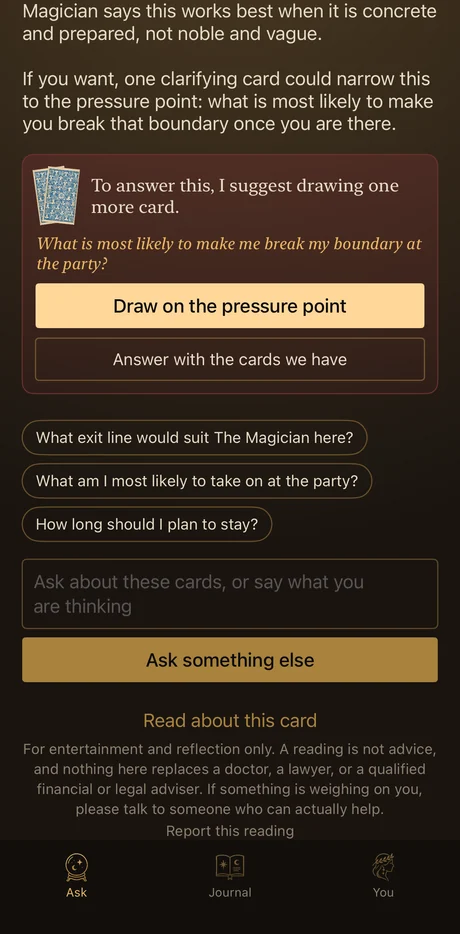
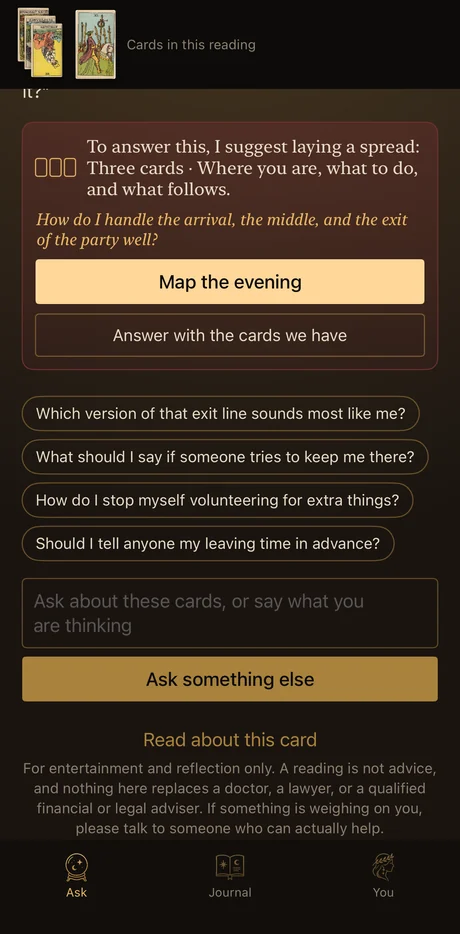
Britannia Tarot treats the card as the opening line rather than the last one. You ask a question in your own words, one card turns over, and you get a straight answer — and then the reading stays open. You can ask something else, say what you see in the picture, draw a clarifying card, lay a whole spread inside the same reading, or come back to it a fortnight later.
The front page is one question box and nothing else. That is deliberate: there is no spread to pick, no birth date to enter and no account in the way of the first card. The question is the interface.
Ask, and then keep asking
Type the question you actually have — should I take the job, will they call, should I go to the party — or speak it, and let the phone turn it into text. The deck shuffles, one card turns over, and the answer comes with it.
Reversals are on, at roughly a third of draws, because this deck was drawn with reversed meanings in mind. A question that takes a yes or a no gets one; a question that does not, does not — see yes or no tarot for where a one-word answer is worth something and where it is worth nothing.
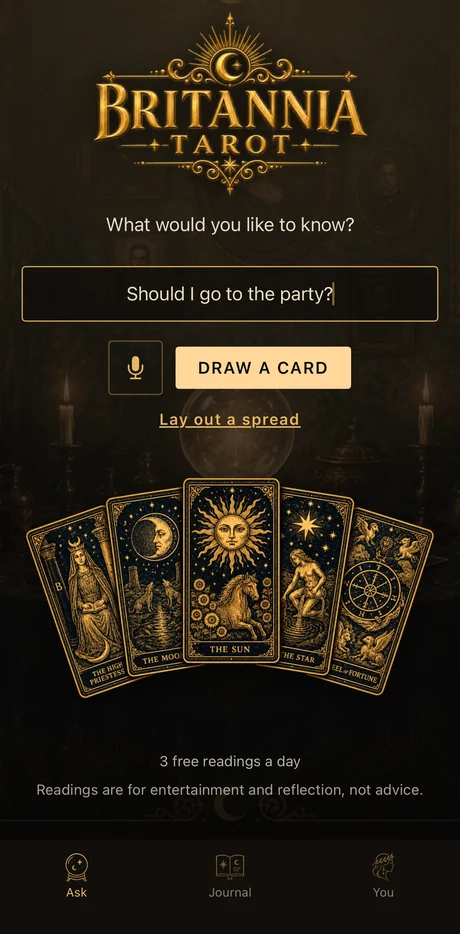
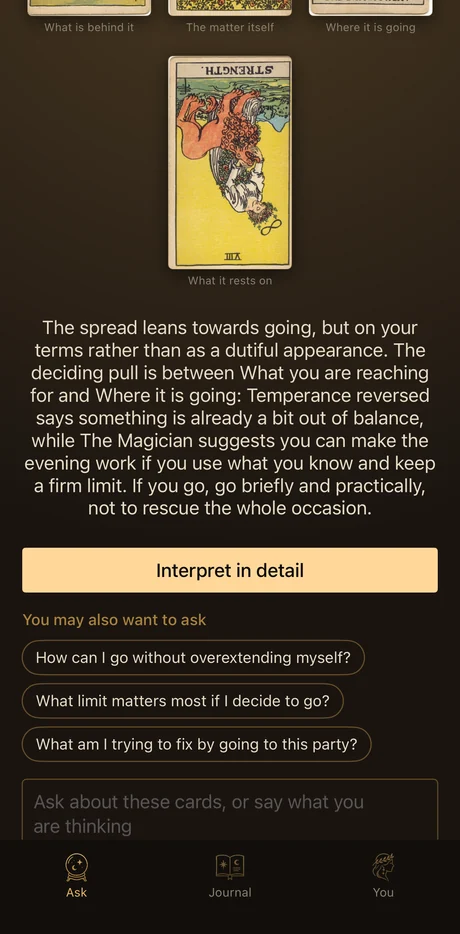
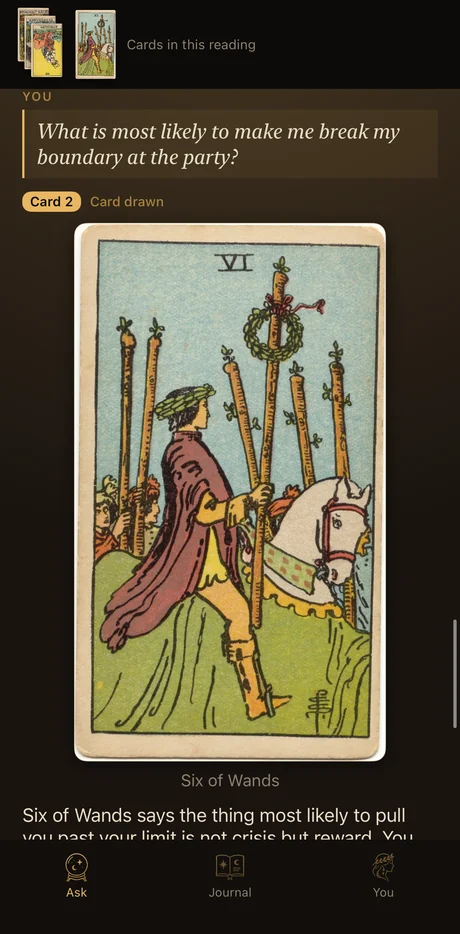
A reading runs for 10 turns before it offers to carry on. There is no counter anywhere on the screen: the limit appears exactly once, when you reach it.
Three spreads, and named places
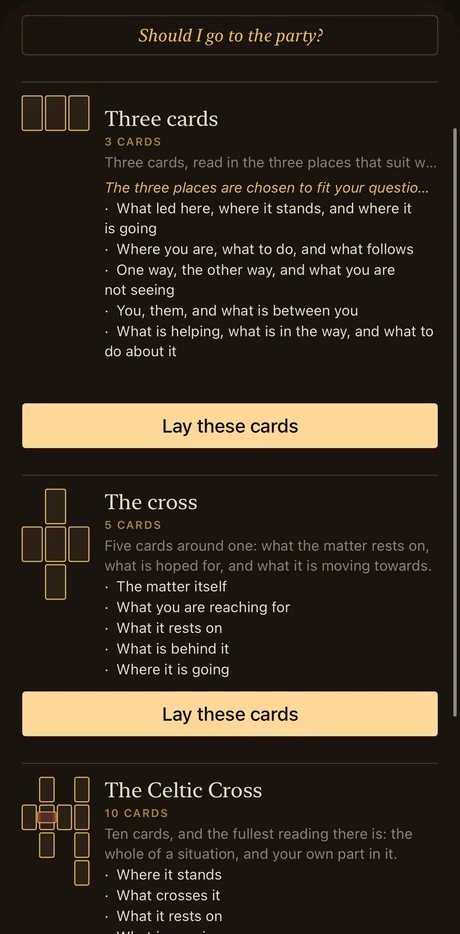
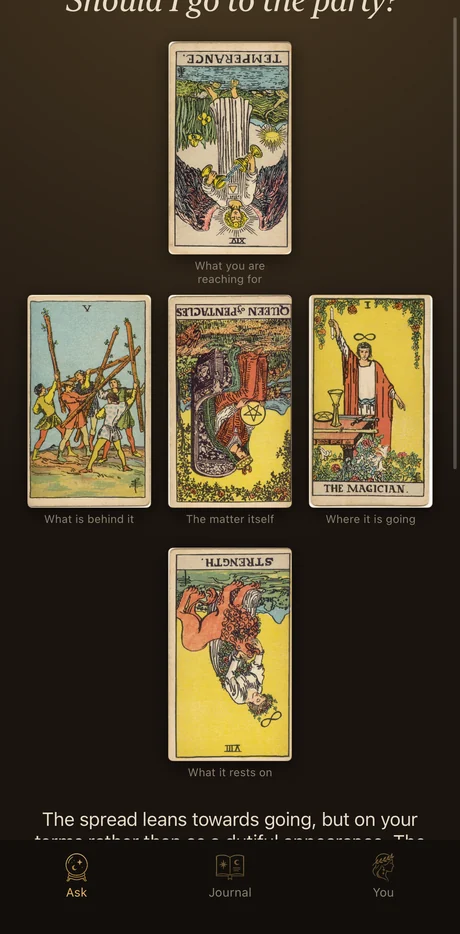
When one card is not enough there are three layouts: three cards, the five-card cross, and the ten-card Celtic Cross. Each card falls in a place that has a name, and the interpretation is about what they say together — the relation between the positions, not five card definitions in a row.
The three-card spread is the interesting one. "Three cards" is a shape rather than a spread, so the framing is chosen to fit your question before the cards are dealt: what led here and where it is going, or one way against the other, or you and them and what sits between you. Choosing afterwards would let the deck decide what the question meant.
It asks what you see
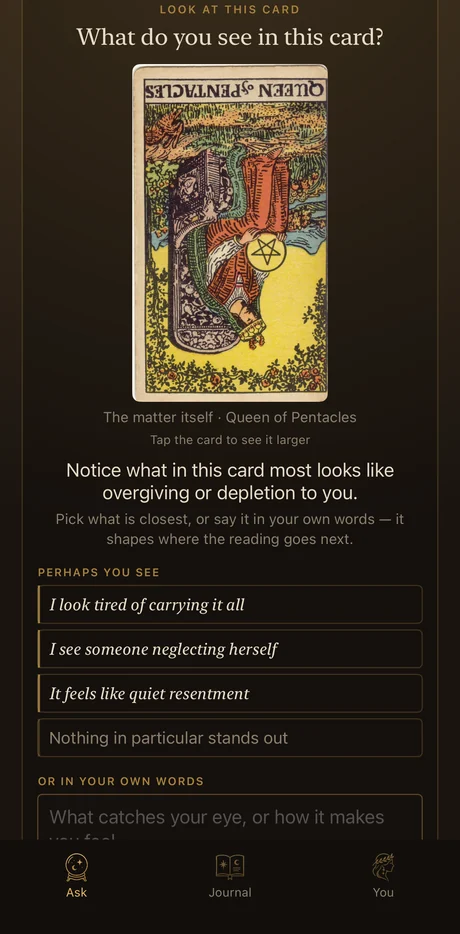
Every so often, before anything is interpreted, the reading stops and asks you to look at the card. What catches your eye first? What does it seem to say about your situation? You can take one of the suggestions or write your own, and you can skip it.
Whatever you answer goes into the reading — not as a correction, but as information about how you are reading the picture today. Say that The Fool looks less like freedom and more like a man about to walk off a cliff, and the reading talks about the cliff.
That is the difference between being told what a card means and being asked what you think. The stock meanings are all here in the card meanings, free, with no reading required; the useful part is what you notice when you hold one against your own question.
The cards remember
Every reading is kept: the question, the cards, the conversation, and the interpretation that came out of it. The journal is a list of readings you can reopen and carry on, not a receipt drawer.
And a later reading can look back. When there is a real connection — the same card turning up against the same worry, months apart — the reading can say so, and name which earlier one it means. When there is no genuine link it says nothing, which matters more than it sounds: an invented connection between two unrelated questions is worse than no connection at all.
This is the part a page that forgets you cannot do, and it is the part that gets better the longer you use it.
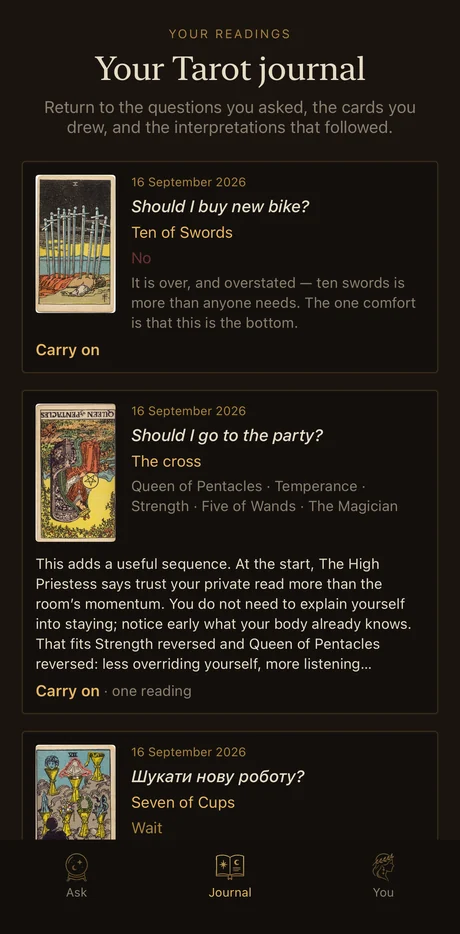
If you would rather see what a whole reading looks like before you start one, there are ten of them written out, question to last line.
Three worlds, one deck
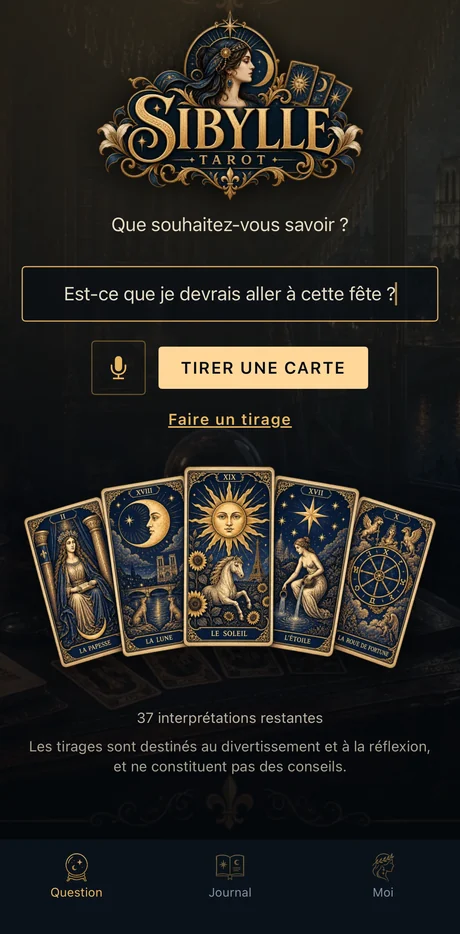
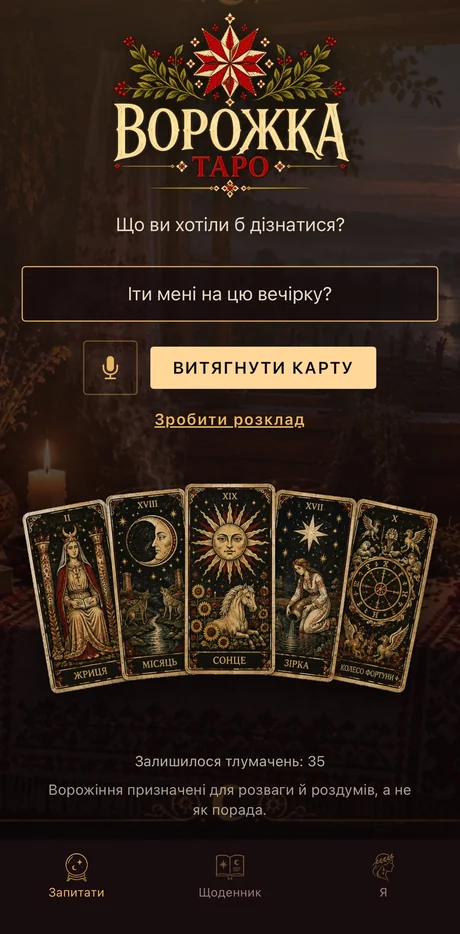
The same deck is read in three different rooms. You choose a world the first time you arrive, and it sets the language, the artwork, the room behind the question and the tone of the reading. You can change it whenever you like.
These are not three skins over one screenshot: each world has its own mark, its own card backs, its own candlelit rooms and its own palette, and the whole interface is written in its language rather than translated around the edges.
What it costs
You can draw a card without an account: 3 free readings a day, each with its short answer. The longer conversations — the ones that carry on — are open to you signed out as well: 1 of them, so you can see what one is actually like before deciding anything.
With an account there are 2 full interpretations a day, free, which do not roll over to tomorrow — and a journal that keeps everything, which is what makes a later reading able to refer back. Beyond that there are readings to buy, and they do not expire.
The honest reason to make an account is that your readings survive a new phone. What is free, and what happens to your question sets out the rest.
What this is, and is not
A tarot reading here is for entertainment and personal reflection. The interpretations are written by AI and can be wrong. Nothing on this site predicts the future, and nothing here replaces a doctor, a lawyer or a qualified financial or legal adviser — which is why that line sits under the answer rather than only in the terms.
Every one of the 78 cards has a page of its own here, to read whenever you want to know more about one you have just drawn.
The deck is the 1909 London deck, illustrated by Pamela Colman Smith and published in December 1909 by William Rider & Son of London. It has been in the public domain since 2022.